
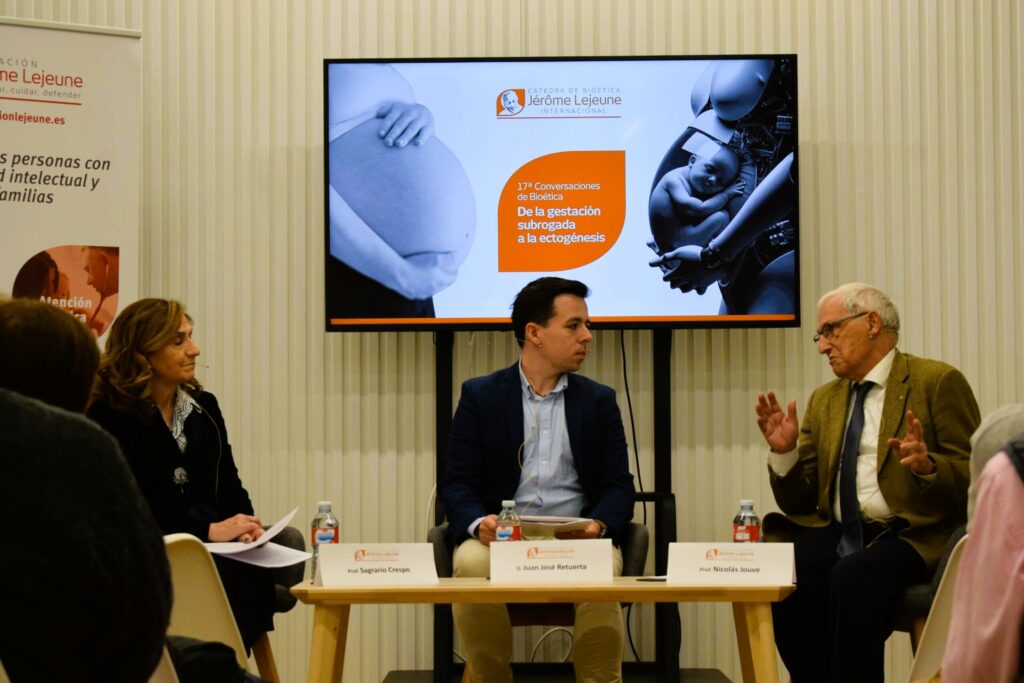
17th Conversations on Bioethics: “From Surrogacy to Ectogenesis”.
A bioethical reflection on how these practices challenge the ontological dignity of the human being from conception to natural death.
On December 4, 2025, the International Chair of Bioethics Jérôme Lejeune held the 17th edition of the Conversations on Bioethics in Madrid, a space for dialogue that takes place twice a year with a clear objective: to reflect, with rigor and depth, on the major ethical challenges posed by contemporary science when it comes into direct contact with human life.
Under the title “From Surrogacy to Ectogenesis,” the meeting offered an ethical reflection on how certain practices related to medically assisted reproduction are reshaping the understanding of the origin of life, the nature of motherhood and filiation, and ultimately the ontological dignity of every human being from conception to natural death.
The session was moderated by Juan José Retuerta Vilariño, a pharmacist specializing in Clinical Biochemistry at the Gregorio Marañón General University Hospital and holder of a Master’s Degree in Bioethics from Francisco de Vitoria University and the Chair itself. In his introductory remarks, he recalled the mission that inspires these Conversations: to study, safeguard, and defend human life, especially the most vulnerable, following the legacy of Professor Jérôme Lejeune, physician and geneticist who never separated scientific progress from the unconditional defense of the human person.
In this context, the moderator introduced the discussion by highlighting a significant figure: in Spain, births resulting from assisted reproductive technologies already account for 12% of the total[1]. This data shows how these practices are now an integral part of our healthcare and cultural landscape and makes even more urgent a bioethical reflection capable not only of reacting to change, but also of anticipating it.
To address this topic, the Chair brought together two distinguished speakers, complementary in their approaches and expertise. On one side, Professor Sagrario Crespo Garrido, PhD in Humanities and Social Sciences and Professor of Bioethics and Deontology at Francisco de Vitoria University, who offered an anthropological and ethical perspective on motherhood, the body, and the maternal-filial bond. On the other, Professor Nicolás Jouve de la Barreda, Professor Emeritus of Genetics at the University of Alcalá and PhD in Biology, who provided the necessary scientific foundation to understand what is technically possible, what is not, and why this distinction is decisive for bioethical discernment.
The dialogue addressed two closely related phenomena. The first was surrogacy, considered not merely as a reproductive technique, but as a practice that introduces a contractual logic into the very origin of human life. It was emphasized that it necessarily requires in vitro fertilization and that, once gestation is “substituted,” a shift occurs in rights in favor of the so-called intended parents, with the consequent risk of instrumentalization of both the gestational mother and the child, reduced to the object of an agreement. The issue of consent, especially in contexts of economic inequality or social pressure, ran through much of the reflection.
The second topic addressed was ectogenesis, presented as an even more radical scenario. The possibility of bringing human gestation to completion outside the mother’s body, within a controlled technological device, inevitably evokes cultural imaginaries such as Aldous Huxley’s Brave New World. During the meeting, a distinction was made between partial ectogenesis, linked to neonatal technologies for the management of extreme prematurity, and total ectogenesis, which envisions a complete separation of gestation from the mother’s body and from family bonds from the very beginning of life. The latter was identified as one of the most concerning scenarios proposed by certain contemporary transhumanist projects.
As an initial stimulus for reflection, the fictional video “Ectolife” was shown, which presents in a promotional manner a supposed system of artificial wombs managed by artificial intelligence. Rather than being considered an immediately feasible prospect, the video served to highlight a deeper issue: how the language of progress, efficiency, or technical solutions to social problems, such as depopulation or infertility, can obscure fundamental questions about the meaning of conception, birth, and the conditions under which they occur.
At this point, the discussion was enriched with concrete scientific contributions: the dependence of human development on the maternal environment, the importance of amniotic fluid, maternal metabolites and hormones, placental microbiota, and microchimerism phenomena. All these elements demonstrate that human development is not an isolated or purely technical process, but a profoundly relational one. Depriving the unborn child of this environment is not a mere detail, but a substantial alteration of their original experience.
The exchange with participants highlighted the depth of the debate. Particularly incisive questions emerged: where do the dignity of the child and the freedom of the gestational mother stand when commissioning parents decide to terminate the contract and demand the abortion of the unborn child? What moral consequences arise from considering the child as a product obtained through a contract rather than as a gift? Is there a real ethical difference between the “sale of a child” and the mercantile logic underlying surrogacy? How can a society coexist with the simultaneous normalization of abortion and these reproductive practices?
The interventions reflected a shared concern: the sense of being confronted with a profound cultural fracture, in which technological progress risks prevailing over the very meaning of human life it claims to serve.
In this context, bioethics is presented not as a reactive or merely normative discipline, but as a forward-looking field, called to read the signs of the times, anticipate future scenarios, and offer criteria grounded in science, law, and moral conscience, before certain practices become consolidated through habit or sanctioned by law. Not everything that is technically possible is, for that reason, ethically acceptable.
The meeting concluded by recalling a central idea of Professor Jérôme Lejeune: “When medicine loses respect for human life, it ceases to be truly medicine.” An affirmation that, far from closing the debate, leaves it open as an intellectual, cultural, and moral task.
[1] National Registry of Activity 2022 – SEF Registry, Ministry of Health and Spanish Society of Fertility (SEF).
The full recording of the 17th edition of the Conversations on Bioethics is available on the Jérôme Lejeune Foundation’s YouTube channel.
