
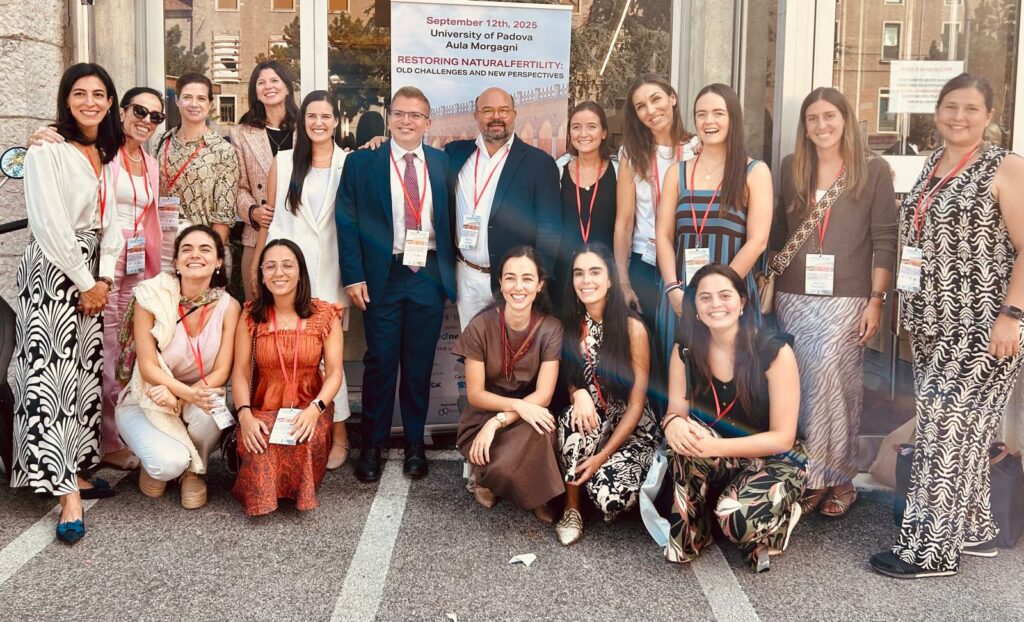
“Restoring Natural Fertility: Old Challenges and New Perspectives”. International Meeting on Medical Updates and Ethical Issues in Natural Procreative Restorative Medicine

On September 12, the first International Congress dedicated to restoring natural fertility (“Restoring Natural Fertility: Old Challenges and New Perspectives”) took place at the University of Padua (Italy). The event brought together more than 250 participants from around the world, including representatives from Italy, Spain, Poland, Albania, Argentina, Peru, the United States, Cameroon, Canada, Croatia, and the Netherlands.
The meeting was opened by Professor Alberto Ferlin, Full Professor of Endocrinology at the University of Padua and Director of the Complex Operative Unit of Andrology and Reproductive Medicine; Dr. Giuseppe Grande, endocrinologist and andrologist in the same Unit; Professor Elena Postigo, President of the International Chair of Bioethics Jérôme Lejeune; and Miguel Gabián, President of the Fertilitas Clinic in Spain.
The Congress primarily involved physicians specialized in reproductive medicine, andrologists, urologists, gynecologists, endocrinologists, and other health professionals, all united by a shared interest in deepening knowledge and offering a new perspective on the treatment of infertility.
After nearly 50 years of Assisted Reproductive Technologies (ART), it is often observed in clinical practice that reproductive medicine has given way to assisted procreation techniques. The Congress emphasized the central role of reproductive medicine, which must first and foremost be medicine: it should diagnose and, whenever possible, treat conditions, highlighting that the primary goal should be, whenever feasible, the restoration of natural fertility.
Infertility should also be recognized as a health issue, such that its diagnosis can represent an important opportunity for prevention, diagnosis, and treatment of relevant health conditions that may otherwise go undetected if patients are referred directly to ART.
The Congress brought together speakers from various countries who are experts in the field of infertility. It was organized by the Andrology and Reproductive Medicine Unit of the Department of Medicine at the University of Padua, in collaboration with Fertílitas, the leading NaProTechnology clinic in Spain, and the International Chair of Bioethics Jérôme Lejeune. This Chair is an international reference in bioethics, based in Spain but active worldwide, dedicated to education, research, and outreach in bioethics, as well as to the defense of human life from conception, following the legacy of Professor Jérôme Lejeune, the geneticist who discovered Trisomy 21 (Down syndrome).
The idea for the Congress arose following the success of the international advanced training course completed last June, entitled “Restorative Medicine for Male Reproductive Health.” This course trained physicians from several countries in the diagnosis and treatment of the male factor in infertility, with the aim of restoring natural fertility (for more information about the 3rd edition of the course, click here).
The Congress addressed in depth issues related to both male and female factors in infertility, focusing on couple infertility, a frequent clinical condition with significant impact. Infertility is defined as the absence of conception after at least 12 months of unprotected sexual intercourse. Approximately 10% of couples worldwide are infertile, and 56% seek medical care. The male factor contributes to or is directly responsible for nearly 60% of cases, yet it remains underdiagnosed and undervalued. Frequently, infertile couples are diagnosed with “idiopathic infertility” without a complete diagnostic process, and many are referred directly to ART. It has been shown that approximately 15% of couples undergo ART without prior andrological evaluation.
This trend has persisted in recent years. However, over the past two decades, new data has emerged regarding the overuse of ART, the lack of evidence of effectiveness in certain cases (such as unexplained infertility), potential short- and long-term risks for children conceived through these techniques, and economic considerations.
Psychological dynamics are often significant in couples experiencing infertility, a topic addressed at the Congress through a presentation on psychological support, which is frequently interpreted solely as support for ART.
ART also raises ethical issues, such as the in vitro production of human embryos, the high percentage of embryos lost (approximately 90%), and concerns related to the dignity of human procreation—ethical factors that should also be considered during the human fertility process.
The participation of more than 250 attendees confirmed the strong interest in the long-standing yet timely topic of restoring natural fertility. As demonstrated by a multicenter study coordinated by the University of Padua and presented at the Congress, restoring natural fertility is possible in more than 40% of couples, including patients with previous ART failures.
This approach is rooted in the medical and humanistic style of Jérôme Lejeune, combining scientific rigor with respect to the dignity of human life and human procreation.
